What Conservation Park's Boardwalk Rebuild Changes Underfoot
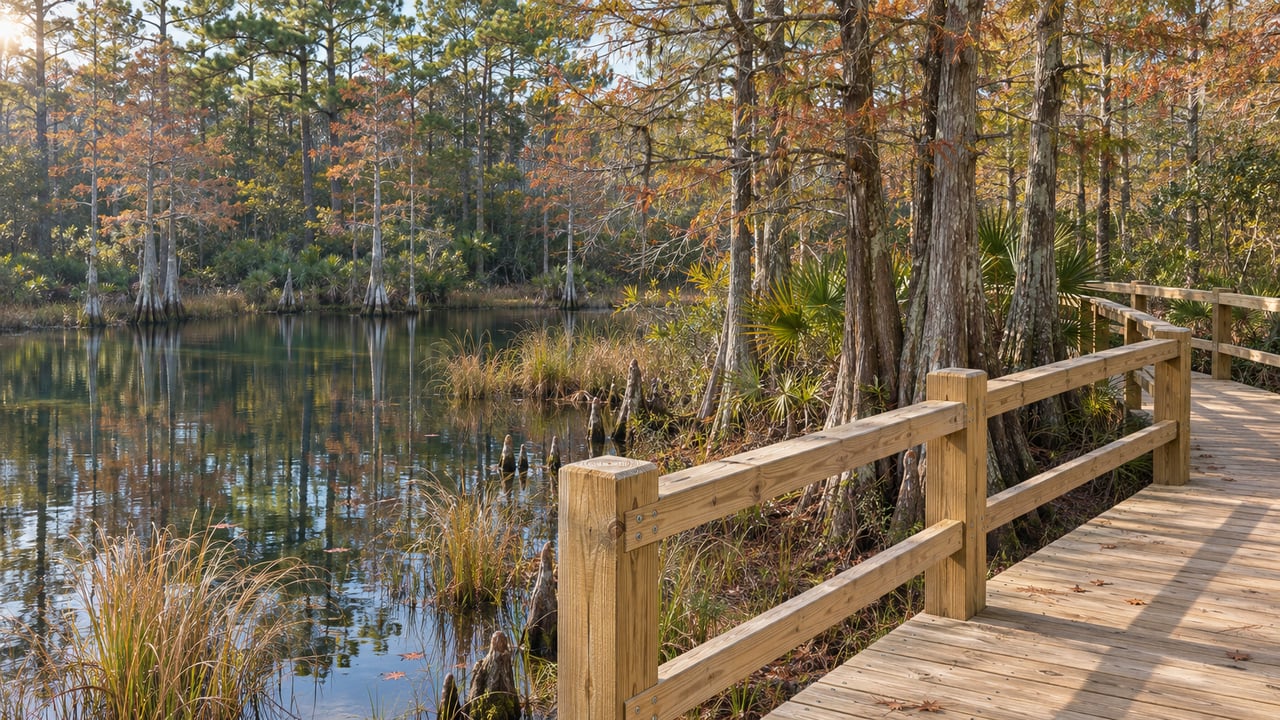
"The park is built around this water distribution system," Jim Moyers, a biologist at the Panama City Beach Conservation Park, told WJHG in 2022. "This water distribution came first, and that's the primary reason that this land that the park is set on was purchased."
The 24-plus miles of free trail off Conservation Drive sit on land the city bought for its treated wastewater. That water keeps the wetlands wet, the wetlands are why the park needed boardwalks, and those boardwalks are now under contract for a full rebuild that city staff expect to happen mostly in the city's 2027 fiscal year.
According to the city's audited financial statements for the fiscal year that ended September 30, 2005, Panama City Beach bought about 3,000 acres that year as a discharge site for reclaimed water. The land cost $3,829,892, and the city estimated the full reuse and receiving-wetlands project, land included, at $15.5 million. A 2017 draft plan for the St. Andrew Bay watershed from the Northwest Florida Water Management District says the city's wastewater facility stopped discharging into West Bay in 2011 and sent its treated effluent to the Conservation Park wetlands instead.
In the same WJHG piece, Moyers said the park releases reclaimed water at 12 sites around the property, and that water flows back into the wetlands. He called it clean, treated water of the same kind the city sells for sprinklers and irrigation. The Visit Panama City Beach listing says tree farming had changed the property's water balance before the city bought it. It describes the restored wetlands as a natural filter for treated water before it reaches St. Andrews Bay.
The acreage shows how much of the park is water. Of the park's 2,900 acres, the city's facility page counts 2,004 as wetland and 908 as upland. More than two-thirds of the park is wetland. A trail can't cross that ground without leaving a mark, so the city built boardwalks over the cypress domes, and the same page puts more than a mile of boardwalk in the park.
City staff explained the problem in a memo for the July 9, 2026 City Council meeting. The boardwalk "has reached the end of its useful service life" after years of weather, rising visitor numbers and age. The memo lists weakened supports, a worn walking surface and reduced structural stability, which had meant more and more maintenance just to keep it safe.
Regular walkers have seen pieces of this before. In July 2022 the News Herald reported that a half-mile stretch of Cypress Pond Trail had closed so crews could replace old, rotting boardwalk wood. The new project covers far more ground. The bid package describes 11 boardwalk sections totaling nearly 7,000 linear feet and calls for replacing everything except the existing pilings.
The staff memo says park staff helped revise the original design, and three of those changes will be easy to spot on a walk.
The deck is going from 6 feet wide to 9 feet so staff can drive ATVs on it for emergencies and maintenance. On a narrow stretch, that also gives a family more room to pass a runner. The railings are changing too. The current fall protection is tensioned wire, and the memo says it needs constant re-tightening because visitors stand on the strands. The replacement is galvanized welded-wire panels with openings too small for a child's shoe. The project also calls for marine-grade lumber under the decking, which is made to be submerged in water. That matters in a park where the city keeps the wetlands wet on purpose.
The bidding drew wide interest. The memo says DemandStar sent the solicitation to 741 potential bidders, 22 parties attended the mandatory pre-bid meeting, and nine bids came in. Southern Construction Service submitted the lowest unit price, $152 per linear foot. Staff estimated the replacement at $1,145,000, including $5,000 for mobilization and demobilization. The agreement is capped at $1,250,000, and the extra $105,000 is a contingency in case any pilings turn out to need replacing. Staff wrote that it doesn't expect that to happen. The city's bid page for PCB26-37 lists the contract as awarded, and WJHG ran a short segment on the upgrades in July.
The memo gives the project a 365-day timeline. The contract came up with three months left in the city's 2026 fiscal year, so staff expects most of the construction in fiscal 2027, the year that began this fall.
Crews work through the park in order. The contractor has to submit a construction sequence for city approval and finish one boardwalk segment before starting the next. Trail closures are to be coordinated with the park biologist. Pedestrian traffic is to stay open during construction unless a plan says otherwise, and any detour needs the project representative's approval.
The work goes one boardwalk section at a time across a park with more than 24 miles of trail. The city's trail map uses color-coded loops of 1.7 miles on green, 4 or 6 on yellow, 5.2 or 6.5 on blue, 9.5 on orange and 11 on red. Brochures at the trailhead list more combinations. If a section is fenced off, another color on the map may still get you your miles.
The reclaimed water is a big reason the birding here is good. The Bay County Audubon Society's guide to birding sites near the beaches calls Conservation Park good year-round, though best in spring and summer. It lists black-bellied whistling ducks, purple gallinules and up to five woodpecker species. In winter it adds an occasional vermilion flycatcher, a small bright-red bird that birders here don't expect to see. The chapter's field trips are free and open to the public, and its field trip page posts schedule updates.
The basics are the same during construction. The park is open dawn to dusk every day with no admission fee. The trailhead has a 4,400-square-foot shelter with restrooms and a drinking-water station, and there are picnic tables and a pavilion you can rent. There's no drinking water out on the trails, so fill your bottles at the trailhead. The city says forestry work in the uplands removes some species and brings back native ones, so expect the pine stands to look managed.
Cyclists can ride in on Gayle's Trails. The network started at Frank Brown Park in 1998, and the city says it now connects with nearly 30 miles of Conservation Park trails.
If the boardwalk you wanted is closed for its rebuild, St. Andrews State Park has a similar walk over water. Its ranger-guided hike, "Nature's Story," runs every Thursday, including Thanksgiving morning, Nov. 26, from 10 to 11 a.m. The park's "Nature Through the Looking Glass" program meets at the Gator Lake Boardwalk on Tuesdays from noon to 2 p.m. and is listed for Dec. 1. Park entry fees apply to both. St. Andrews charges $8 per vehicle carrying two to eight people, $4 for a single-occupant vehicle, or $2 for anyone arriving on foot or by bike.
West of town, Camp Helen State Park is open from 8 a.m. to sunset every day of the year. Entry is $4 per vehicle or $2 on foot or by bike. Its 1.8-mile North Trail is the longest of its marked routes.
If you'd like a home in Panama City Beach within an easy ride of Conservation Park and Gayle's Trails, call Abbott Martin Group and we'll map the options with you. Discover Your Emerald Coast Home.
It is essential to love the people you work with, and that indeed is the case within our team, where culture comes first. At Abbott Martin Group, we celebrate success and pick each other up when needed. A strong culture is vital to having a healthy work environment. We focus on creating a positive impact for our families and the customers we serve. The Emerald Coast is an environment of healing; we are always here for each other.
Stay up to date on the latest real estate trends.
November 26, 2026
November 19, 2026
November 12, 2026
November 5, 2026
November 5, 2026
October 29, 2026
Including County Registration and Daily Operating Rules.
We pride ourselves in providing personalized solutions that bring our real estate clients in Miramar Beach closer to their dream properties and enhance their long-term wealth. Contact us today to find out how we can assist you!